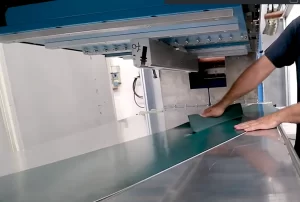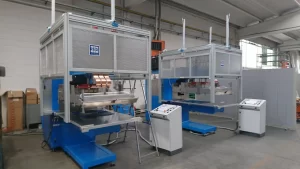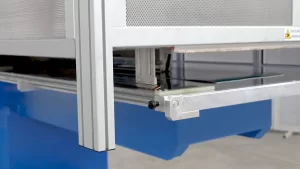

High-frequency welding creates unbreakable joints for conveyor belts in PVC, PU, and thermoplastic materials. Unlike stitching or gluing, HF welding fuses materials at a molecular level for seams that outlast the base belt itself.
Why conveyor belts fail and how HF Welding solves it
Common conveyor belt failures cost thousands in downtime:
- Delamination at splices under continuous flexing and load
- Stitch failures creating gaps that trap debris
- Adhesive breakdown from oils, chemicals, and temperature swings
- Premature wear at joints 2-3x faster than belt body
High-frequency welding eliminates these issues by creating monolithic seams with no threads, glue lines, or weak interfaces. The welded joint becomes the strongest part of the belt.
REG Galbiati technology for conveyor belt production
REG designs custom HF welders proven across automotive, packaging, and conveyor belt manufacturing. The same precision engineering delivers reliable belt splicing:
- Custom platens sized for belt widths from 300mm to 2000mm+
- Power optimized for PVC/PU belt thicknesses 1-8mm
- Precise parameter control (power, time, pressure) for repeatable splices
- Combined weld-and-cut capability for clean edges
- Versatile setups for straight splices, chevron patterns, or custom profiles
Who benefits most from Reg HF belt welders
Ideal for manufacturers producing:
- PU/PVC conveyor belts for industrial applications
- Modular belts with finger splices
- Custom profiles for elevation or curve applications
Contact REG if you face:
- Splice failures within 3-6 months
- High costs from frequent belt replacements
- Need for custom splice geometries
- Transition from mechanical/adhesive methods
Proven Results in Real Production
Manufacturers switching to HF welding report significant reduction in splice-related failures and longer belt life in continuous operation. Clean, gap-free splices improve operational reliability and reduce maintenance downtime.