
How to Specify Weld Quality: Turning Requirements into Measurable Criteria
For a high-frequency welding project, weld quality needs to be described in terms that can be assessed: what the joint must do, how it will be inspected, and what result will be considered acceptable. This matters before choosing a machine, tooling or process settings. For HF welding of thermoplastic materials,
HF Welding Investment Checklist: Is Your Joining Process Costing You More Than You Think?
Many manufacturers underestimate the true cost of their joining process. Scrap, rework, downtime, and customer complaints related to welds often add up to far more than the investment required for a proper HF welding solution. If your joining process creates frequent problems, it may be costing you significantly more than
HF Welding vs Alternative Joining Methods: When High Frequency Is the Right Choice for Thermoplastics
High-frequency (HF) welding is one of several methods available to join thermoplastic materials, but it is not always the best choice. HF welding is the right choice when you need strong, uniform, and repeatable joints on compatible thermoplastics, especially for medium to high-volume production where quality and speed matter. When
When to Replace or Upgrade Your HF Welding Machine
High-frequency welding machines are often seen as long-term investments. In many factories, the same equipment runs for years, sometimes decades. But at a certain point, an old or poorly suited machine can stop being an asset and start becoming a hidden constraint on quality, efficiency, and growth. Choose to replace
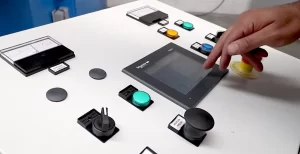
Precise Process Control in HF Welding
In high-frequency welding, process control is not a secondary detail. It is the foundation of weld quality, repeatability, and production stability. When the key parameters are correctly set and consistently maintained, HF welding becomes a reliable industrial process rather than a variable manual operation. The four key parameters The quality
Clean Technology in HF Welding: A Safer, More Controlled Process for Plastics
HF welding is often described as a clean joining technology because it generates heat directly inside the material, without open flames, hot air, or contact heating along the seam. For manufacturers working with plastics and technical textiles, this means a joining process that is easier to control, more repeatable, and
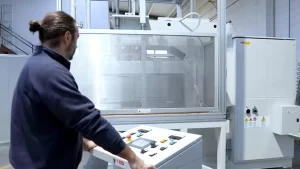
High-Frequency Welding Machine: What Problems Does It Really Solve?
High-frequency welding machines solve a very specific set of production problems: weak, irregular, slow or hard‑to‑control joints on thermoplastic materials. In other words, they turn an unstable joining step into a repeatable industrial process. Weak or inconsistent joints Many traditional methods (gluing, stitching, hot air, impulse sealing) create joints that
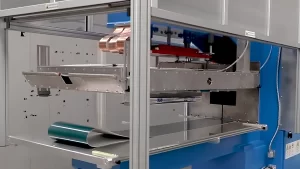
How to Choose the Right HF Welding Machine
Choosing the right HF welding machine is a critical step for any company that wants stable production, consistent quality, and a solution that fits its actual industrial needs. At REG Galbiati, we design custom-made high-frequency welding machines for industrial applications, so the right choice always starts from the product, the
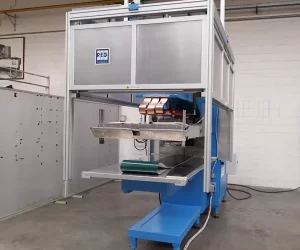
Automation and High-Frequency Welding Machines: From Manual to Industrial Automation
When production is manual, quality and consistency depend on the operator. Automating high-frequency welding changes this dynamic: you get repeatable seams, predictable cycle times and a process that stays stable across different production runs. REG Galbiati positions its machines as custom-made solutions for industrial applications where quality and repeatability are