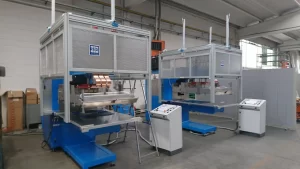
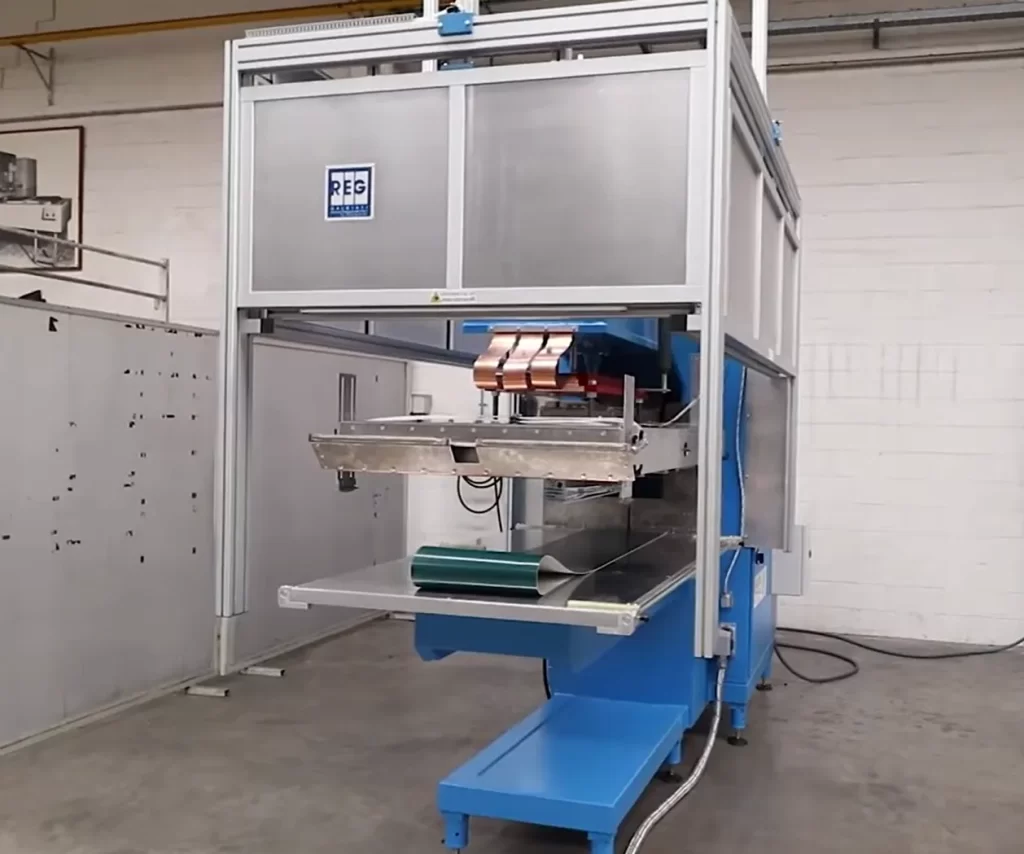
When production is manual, quality and consistency depend on the operator. Automating high-frequency welding changes this dynamic: you get repeatable seams, predictable cycle times and a process that stays stable across different production runs. REG Galbiati positions its machines as custom-made solutions for industrial applications where quality and repeatability are essential.
Why automation matters in HF welding
Manual HF welding can work for small volumes or prototypes, but it becomes a bottleneck when output needs to grow. Automated systems remove part of the human variability, reduce rework and allow you to plan production more reliably.
Automation is not only about adding robots. It can also mean:
- Standardized clamping and material handling
- Consistent pressure and timing per cycle
- Integrated load/unload systems
- Cycle monitoring and parameter control
These elements are aligned with the way REG presents its machines as custom solutions built for specific production needs.
REG’s approach to custom, industrial machines
REG Galbiati designs high-frequency welding machines su misura for customer requirements. The company highlights long experience in the sector and a wide range of industrial applications, including automotive, packaging, conveyor belts and textiles.
A custom machine can be:
- sized for your specific product dimensions
- tuned for your material thickness and type
- configured for your production volume and speed
- adapted to fit your existing line or layout
That custom approach is what makes automation feasible for more companies, not only for very large productions.
How automation improves production
Automation in HF welding brings practical benefits that match industrial priorities:
- Stable production: cycles are consistent, not dependent on operator fatigue or skill level.
- Reduced waste: fewer defective seams and less rework.
- Better planning: you can predict output more accurately and plan shifts with confidence.
- Scalability: when demand grows, you increase hours or speed instead of hiring more operators.
These are the same priorities that drive companies to choose custom machines from REG: reliability, quality and an industrial process that can grow with the business.
When to consider automation
Automation is worth evaluating when:
- Your volumes are high enough that manual welding becomes a bottleneck
- Quality issues are linked to seam inconsistency or operator variation
- You need to scale production without multiplying operators
- You want to reduce variability and improve traceability
If this is your situation, the next step is to share your process data and requirements. REG can then evaluate whether a custom HF machine, with automation adapted to your case, is the right solution.